

- Mar 18, 2026
- Posted by: Sébastien Bonneau
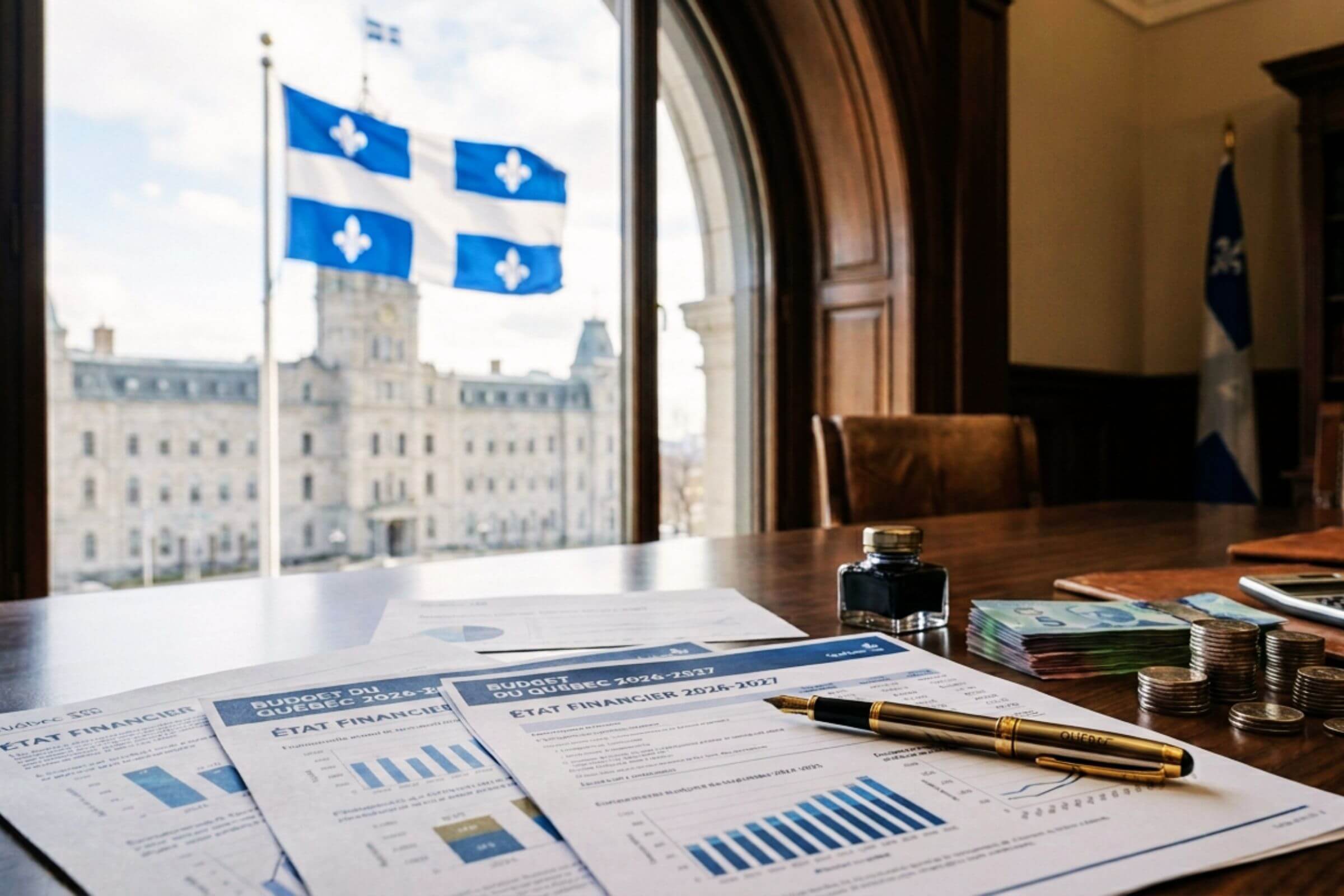
On March 18, Finance Minister Éric Girard tabled what feels like a transitional budget, the 2026-2027 edition titled “A responsible budget with targeted measures for Quebecers.” Coming at a time of global uncertainty and protectionist threats south of the border, and just weeks before the CAQ chooses its new leader on April 12, the document walks a fine line: it delivers some concrete help without opening the spending floodgates.
Overall, the government is rolling out nearly $9.6 billion in additional measures over five years. The focus is on shoring up public services, giving the economy a nudge, shielding households from cost-of-living pressures, and looking after the most vulnerable, all while sticking to the long-term goal of balancing the books by 2029-2030.
Fiscal Snapshot
Quebec’s economy is holding up better than many feared. Real GDP growth is forecast at 0.8% this year, edging up to 1.1% in 2026 and 1.4% in 2027. The deficit for 2026-2027 lands at $6.3 billion (about 0.9% of GDP), and the net debt-to-GDP ratio continues its slow decline toward 32.5% by 2037-2038. Not flashy, but steady. On the infrastructure front, the Quebec Infrastructure Plan jumps to $167 billion over ten years, with more than $5 billion in extra spending over the next six years. Notably, 71% of the money now goes to maintaining and repairing what we already have a realistic shift given the aging state of roads, bridges, and buildings.
What’s in It for Businesses?
The government is putting over $1.7 billion toward accelerating Quebec’s economic transformation. Highlights include:
- $693 million to help companies adapt to the new global reality, including $410 million earmarked for future-oriented investment projects.
- Up to $2 billion more in capitalization for investment funds, specifically to keep strategic head offices in the province.
- A fresh $500 million loan-guarantee fund for Indigenous communities wanting to take part in major economic initiatives.
- $283 million to strengthen innovation, tech adoption, and even productivity in construction.
- Over $580 million for SMEs across regions, with extra attention to tourism and the bio-food sector.
- $365 million to bolster the struggling forestry industry.
- $429 million to support culture, media, and the audiovisual sector.
It’s a pragmatic package aimed at making Quebec more competitive without massive new subsidies.
Help for Quebecers and Communities
On the individual side, more than $3.6 billion over six years is directed at families and communities. The biggest slice, nearly $2.4 billion over five years, tackles the cost of living, homelessness, mental health, domestic violence, and housing access. Specific moves include:
- $846 million to convert 5,000 unsubsidized childcare spaces to subsidized ones and keep the school tax increase capped at 3%.
- $741 million to build 1,000 affordable housing units and renovate existing stock.
- $264 million to improve services for people experiencing homelessness and mental health challenges.
- $260 million to expand shelters and support for women facing domestic and sexual violence.
These are targeted, measurable actions rather than broad tax cuts going into an election cycle.
The Political “Cushion” Everyone Is Talking About
One detail that immediately caught attention is the $250 million per year in explicit new fiscal room left unallocated over the next five years, roughly $1.3 billion in total flexibility. Minister Girard openly said this envelope is there for the incoming CAQ leader (whether Christine Fréchette or Bernard Drainville) to fund their own priorities or campaign commitments.
On top of that, the budget already includes a $2 billion contingency reserve for 2026-2027 alone, part of an $8 billion envelope over five years that can cover unexpected needs or new announcements.
Opposition parties wasted no time calling it a pre-election war chest or the “Fréchette-Drainville cushion.” From a strategic viewpoint, though, it gives the next premier some real maneuvering room in an unpredictable environment without forcing Girard to lock in spending today. Whether it ends up feeling prudent or purely political will depend on how it’s actually used in the coming months, the state of the economy and even the humour of voters.
Bottom Line from Our Perspectives
For Perspectives Government Strategies, it is a sober, disciplined budget that avoids big new spending sprees while still delivering visible support where it’s needed most. It reinforces core services and infrastructure, gives businesses tools to adapt, and offers targeted relief to families and vulnerable groups. For businesses, investors, and regional stakeholders watching Quebec, the real story may unfold after April 12 when the new leader decides how to deploy that $250-million annual flexibility and the broader contingency reserve, probably with a cabinet shuffle followed by a Spring Inaugural Speech and an Economic Update.
We’ll be tracking closely how these choices shape the pre-election landscape and what they mean for economic development across the province. If you’re navigating these shifts in your sector, feel free to reach out. We’re happy to discuss the implications in more detail.
Additional information
https://www.cbc.ca/news/canada/montreal/quebec-2026-budget-9.7130619